
Warehouse cleaning isn’t office cleaning at a larger scale – it’s a different risk setting. Forklifts, high racks, dock traffic, and industrial gear mean the work must fit the site.
A warehouse cleaning contract should set the rules for safety, access, chemicals, supervision, and contact between the site and the cleaning provider. Done well, it makes cleaning part of the site’s daily work, not an add-on squeezed in around stock and time pressure.
Why warehouse cleaning WHS must be in the contract
Warehouse conditions change through the day in a way office spaces usually do not. A floor that is clear at 6am can become a spill area after unloading. A quiet aisle can turn into a busy walk route during picking. A task that would be simple in an office can become high risk near mobile plant.
WHS Compliance is also a shared-duty job. Your organisation controls the site, traffic routes, plant movement, and site timing. The cleaning contractor controls its workers, methods, products, and training. Both sides hold WHS duties and consultation responsibilities at the same time.
That is why warehouse cleaning WHS needs clear clauses, not a vague scope of work. Regular talk between both sides matters too, especially when the layout changes or new plant arrives. This is the kind of safety cleaning that works best when the risks are known upfront.
What a strong WHS warehouse cleaning contract should include
- Site risk checks before work starts
- Proof of worker induction and task training
- Clear rules for safety data sheets, labels, and chemical storage
- Agreed cleaning times and exclusion zones around active work
- Incident, near-miss, and hazard reporting steps
- Escalation contacts for after-hours or unsupervised work
- Review points after incidents, site changes, or poor results
These clauses matter because they make safety easy to measure and remove doubt about who is responsible when a hazard sits between the cleaning task and warehouse work.
Key safety points for warehouse cleaning
Site induction and access control
A cleaner entering a warehouse needs more than a swipe card or a loading bay note. Induction should cover the site’s real hazards: forklift routes, pedestrian walkways, emergency exits, restricted areas, spill response, and alarm steps. If cleaning happens alone or after hours, induction should also cover lone-worker check-ins.
Access should match the risk. Low-risk areas like offices and amenities may only need standard induction. Loading docks, battery charge areas, waste zones, or production-adjacent spaces may need an escort, sign-in, or a rule that work stops when mobile plant is nearby.
A contractor cannot manage hazards it has not been told about. A facility manager should not assume a cleaner knows site rules just because they have worked in another warehouse.
Forklift and vehicle traffic
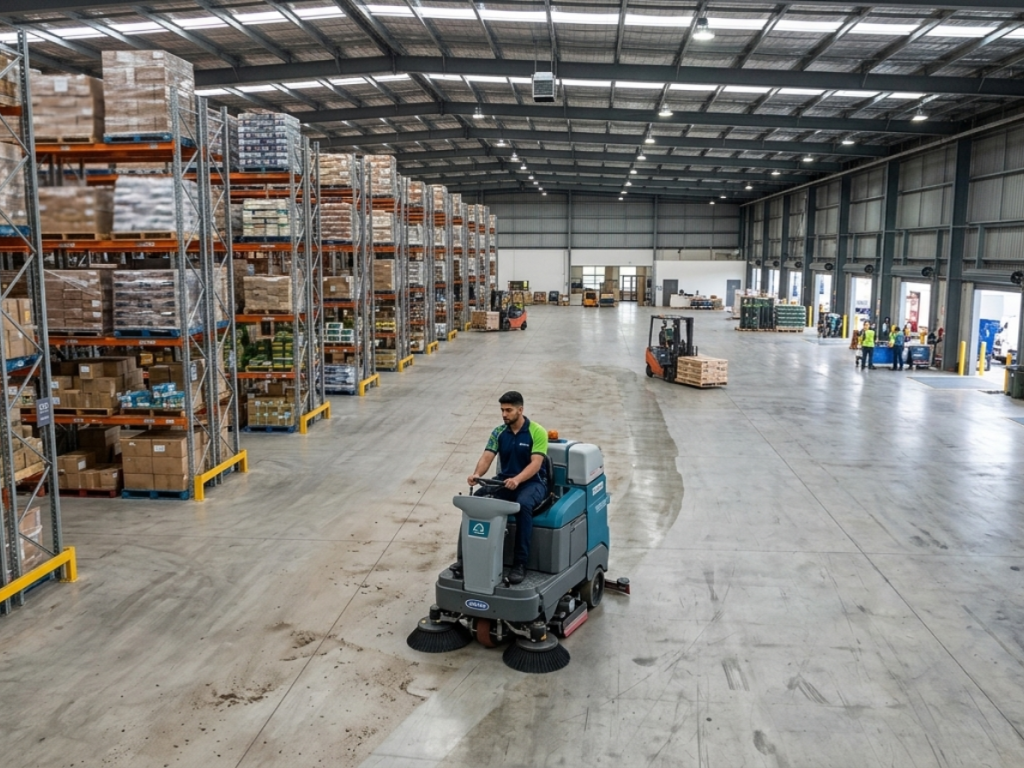
Cleaning around active forklift and vehicle movement is one of the biggest risks in warehouse cleaning WHS. Workplace traffic management should account for where pedestrians and vehicles interact, including loading areas, blind spots and periods of high traffic. Good practice includes:
- Linking cleaning to the site’s traffic plan, not treating it as a separate job
- High-visibility clothing for all cleaning staff in active zones
- Scheduling higher-risk tasks, such as aisle scrubbing or dock sweeping, around quiet windows
- Using cones, barriers, and spotters when the task cannot be timed around traffic
- Telling supervisors before cleaning traffic aisles
- Reporting damaged barriers, floor marks, or poor lighting at once
This is also a key part of warehouse cleaning contractor safety, because traffic control only works when the cleaner and the site team use the same plan.
Racking and high-storage areas
Dust and debris on or around racking is not just a tidy-up issue. It can hide damage and affect load stability. Cleaning around racks should be planned to avoid stored loads, and staff should never access racking directly without the right training and gear.
High-reach and elevated cleaning
Warehouses with high ceilings, mezzanines, or raised walkways need height access for cleaning. This should only be done with proper equipment, such as scissor lifts or rated ladders, and with staff trained in working at heights. It should not be treated as an extension of floor cleaning.
Working at heights should be planned around the risks of falls and, where possible, controlled from ground level. Where elevated work platforms are required, workers should have the appropriate training and equipment for the task.
Chemical safety
Industrial cleaning often uses stronger products than office cleaning, such as degreasers, solvents, and sanitisers. A sound approach includes:
- An up-to-date chemical register with accessible safety data sheets that workers can reach
- Correct labels on all containers, including decanted bottles
- Keep chemicals that clash apart
- PPE matched to the product and task, not to habit
- Extra care for sites handling food, drugs, or export-sensitive goods, where contamination risk and product fit matter more than usual
The same approach is expected in industrial cleaning safety Australia: know the product, label it well, store it well, and train the team to use it safely.
Slips, trips, and housekeeping standards
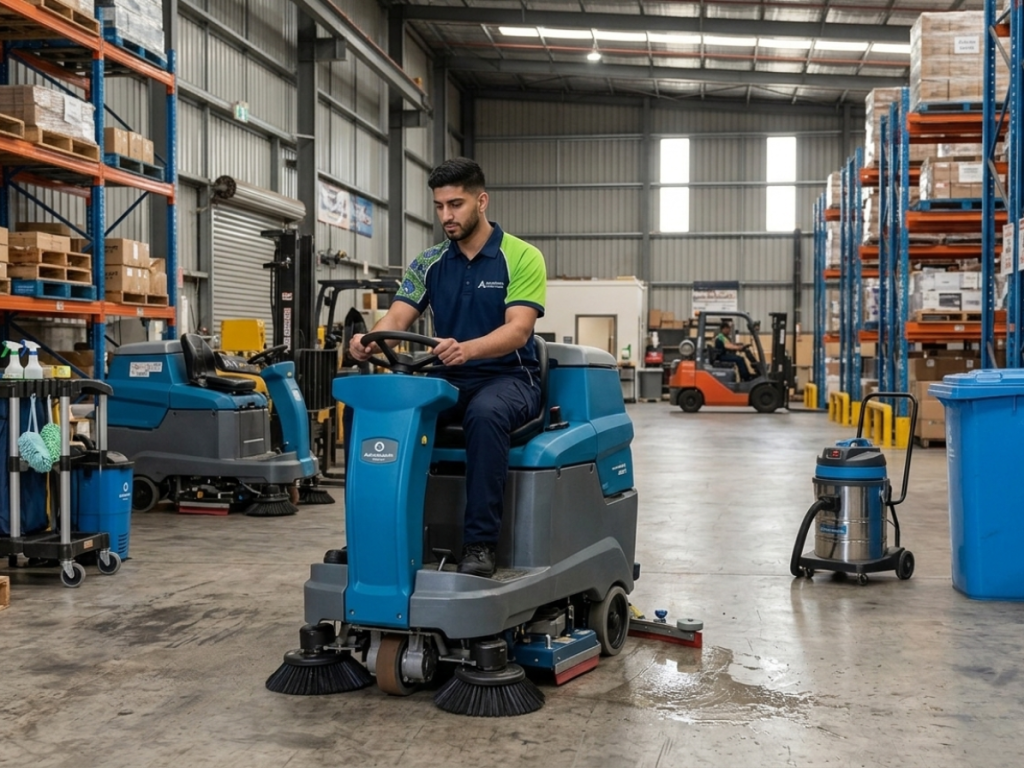
Cleaning done well reduces slip and trip risk. Done badly, it can create it. Wet floors, trailing cords and hoses, and poorly stored gear all turn a routine task into a hazard.
A good contract sets a clear standard: warning signs go up before mopping and come down once the floor is dry, emergency exits stay clear, and equipment is never left in pedestrian routes. It is also worth saying how spills are ranked. A spill in a forklift aisle usually needs immediate action, not a place in the next scheduled clean.
These are safe warehouse cleaning practices that keep the site moving and cut avoidable harm.
A pre-start checklist worth confirming
Before work begins on a warehouse site, it is worth confirming the contractor has covered:
- Cleaning zones clearly defined, including amenities, offices, docks, and warehouse floor areas
- High-risk areas identified, such as traffic aisles, waste areas, battery charging zones, and mezzanines
- Site induction process and required PPE reviewed
- Chemical approval and SDS access confirmed
- Machinery, electrical safety, and equipment storage agreed
- Clear lines for who reports hazards and who receives those reports
- Emergency contacts and after-hours steps documented
This is worth revisiting whenever the warehouse layout, working hours, or product mix changes. A scope that was right a year ago may no longer match how the site runs today.
Training, supervision, and ongoing review
Warehouse cleaning staff need task-specific training, not just general cleaning experience. Manual handling, chemical use, spill response, and site traffic rules are all part of safe work in this setting.
Supervision should match risk. A routine amenity clean needs little oversight, while a floor scrub during a busy shift needs closer coordination with your team.
Ongoing review matters too. A short, regular check-in about incidents, missed cleans, repeated spills, or worker feedback keeps the arrangement active instead of stale. If something goes wrong, the best fix is often practical: change the time, add a barrier, improve light, or retrain staff.
Questions to ask a contractor about warehouse-specific WHS
- Do your staff have training for forklifts and vehicle traffic?
- How do you manage cleaning times around active warehouse work?
- What is your process for high-reach cleaning at our site?
- How do you handle access to higher-risk areas like docks or battery charge zones?
- How do you manage dust, debris, and chemical use for our type of operation?
A contractor with real warehouse experience should answer these clearly, not with generic office cleaning language. That is a key marker of warehouse cleaning contractor safety.
The bottom line
Warehouse cleaning needs a different WHS approach from standard commercial cleaning. It must account for vehicle traffic, height access, industrial gear, and the daily rhythm of an active site.
The best setup treats the contract as a live safety frame, not a static file: clear scope, honest site info upfront, and a contractor that understands your layout, your people, and your busy times. That is the heart of safe warehouse cleaning practices and good warehouse cleaning WHS.
This approach also helps wider facility cleaning work, but it matters even more in an active warehouse.
Associated Cleaning has been providing commercial cleaning across Australia since 1969. Get in touch with us today to arrange a free site inspection and no-obligation quote, and discover how a tailored commercial cleaning program can support your business. Call our team at 1300 943 ACS or visit our website.