
Choosing a commercial cleaning provider for large buildings is not the same as hiring for a small office. Scale changes everything: staff numbers, access, zone control, and the cost of uneven work. A multi-floor building cleaning provider needs stronger systems than a small office team. A commercial cleaning company for large facilities can look strong on paper and still fall short if it lacks the structure to run a big site.
This guide shows what really separates a reliable cleaning contractor for large sites from one that will struggle.
Start With Your Building’s Real Needs, Not the Sales Pitch
Before you ask for quotes, map your site first. That gives you a fair basis for comparison and helps stop a low headline price from turning into a string of extra charges later.
Consider:
- Layout and scale — number of floors, entrances, lifts, stairs, amenities, and shared spaces
- Occupancy patterns — standard business hours, after-hours tenants, weekend use, or event periods
- High-traffic zones — foyers, bathrooms, kitchens, lift lobbies, end-of-trip facilities, car parks
- Sector needs — offices, strata, industrial, education, or healthcare-adjacent sites all carry different expectations
- Security arrangements — access cards, keys, alarm steps, contractor sign-in, restricted areas
- Waste streams — general waste, recycling, confidential document disposal, or other site-specific processes
In enterprise cleaning services Australia, a good provider should ask detailed questions about these points before it prices anything. A quote that arrives without a proper site walk-through or a clear talk about how the building runs is built on guesses, not your actual site.
Why Scale Changes the Choice
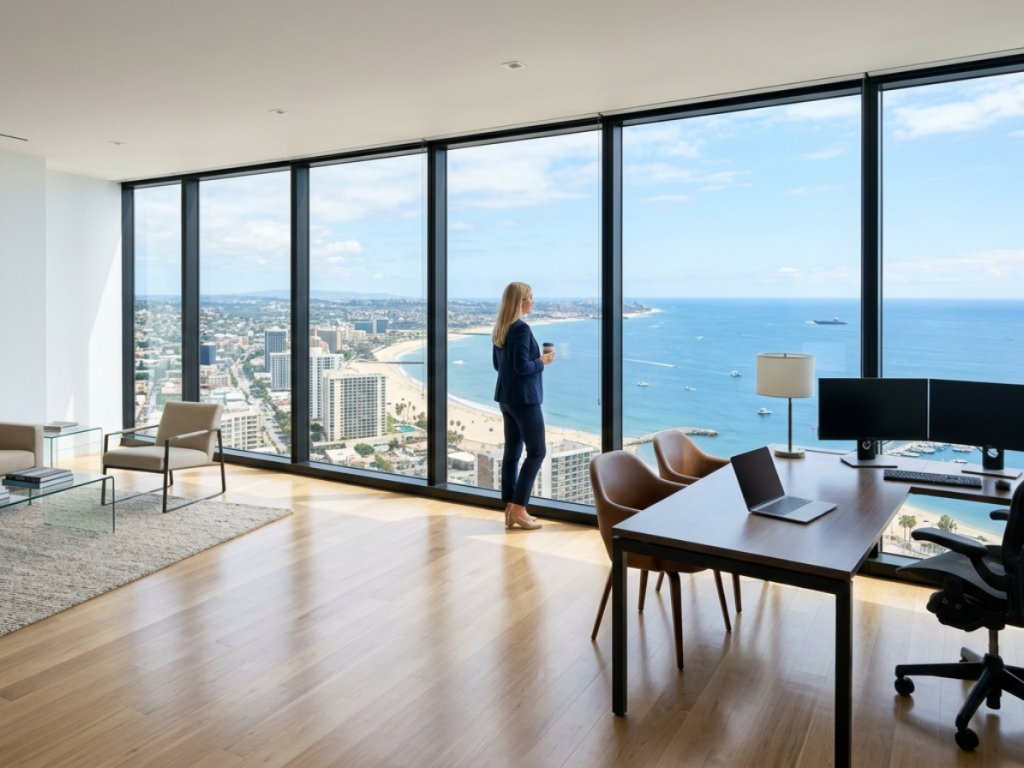
In a small office, one reliable cleaner and a simple checklist can cover most of what is needed. In a large commercial building, you are usually dealing with multiple floors or zones, larger teams working in shifts, more complex access and security rules, and a much higher cost of failure. A missed task or a schedule gap is far more visible, and far more disruptive, in a building with hundreds of occupants than in a small office with a handful of staff.
That is why the choice shifts. Price still matters, but it stops being the main factor. Management structure, consistency, and the provider’s internal systems matter far more than they do for a smaller contract.
What to Look for in a Provider for a Large Building
Real large-site experience, not just size on paper
A national footprint or a long client list does not automatically mean a provider can handle commercial cleaning services for a big site. Ask about buildings that are similar to yours in size and complexity. How many staff do they roster for a comparable site? How do they supervise work across multiple floors or zones?
Formal quality systems
For a large building, informal quality control is not enough. A supervisor who occasionally walks the floor cannot catch everything. Look for a provider with documented, auditable quality systems. Certifications like ISO 9001 are one sign of this, since they require a business to have consistent, separately verified processes for training, supervision, and issue resolution. See our guide on ISO 14001 vs ISO 9001 for what these certifications mean in practice.
Clear management structure and one point of contact
In a large building, things will go wrong from time to time: a missed area, a staffing gap, an access issue. What matters is how fast and how clearly that gets fixed. A reliable provider should offer a clear escalation path and a true single point of contact who is accountable for your site, rather than making you chase whoever answers the phone. These expectations should be clearly defined in your RFP requirements, so you know exactly who is responsible for managing your cleaning service before you appoint a provider.
The ability to scale and adapt
Large buildings change. Tenants move, demand shifts with the seasons, a new wing or floor opens, or one-off events need extra cover. A provider suited to large-site work should be able to flex staffing and scope without a lengthy rework every time something shifts.
Technology and real-time visibility
For a site of any real size, verifying that cleaning has actually happened, and to what standard, should not rely only on trust or occasional manual inspection. Providers that use digital verification tools such as GPS-based check-ins, task tracking, and real-time reporting can give you much better visibility across a large site than a paper system ever will. This is built into our own operations through ACS Connect, our real-time platform for tracking attendance and managing tasks across every site we service.
WHS systems built for a complex site
Larger buildings often carry more complex safety issues: multiple contractors on site, shared plant rooms, loading docks, or after-hours lone work across a big footprint. A provider should be able to show real WHS systems that fit that complexity, not just a generic policy document. These systems should align with Australia’s work health and safety framework and clearly address how risks are identified, controlled and monitored across the site. If part of the site is plant-heavy or high-risk, you may need industrial cleaning services as well as routine office care.
Staffing consistency, not just staffing numbers
Cleaner site know-how has real value in a large building. Staff who know the site understand access points, tenant sensitivities, peak times, and recurring trouble spots. Frequent turnover tends to show up as missed tasks, retraining gaps, and uneven standards. It is also worth confirming that staffing arrangements meet the requirements of the Cleaning Services Award, which covers employees in Australia’s contract cleaning services industry. Ask directly about staff retention, training, and whether the provider relies heavily on subcontractors. Subcontracting is not always a problem, but if it is used, the provider should still control induction, supervision, insurance, and quality outcomes.
Transparent, scalable pricing
Pricing for a large building should be based on a clear scope: square metreage, frequency, and zone-specific needs, not a flat estimate. A provider who can explain its pricing structure clearly, and who flags likely extra costs upfront such as periodic deep cleans, specialist areas, or out-of-hours work, is usually more trustworthy than one offering a very low flat number for a complex site.
Questions to Ask When Comparing Providers
- How many staff do you typically roster for a building of our size, and how is supervision structured across shifts?
- What quality assurance systems do you have in place, and can we see evidence of them such as certifications, audit records, and reporting?
- Who is our day-to-day point of contact, and what is the escalation path if something is not resolved quickly enough?
- How do you handle scaling up or down if our building needs change?
- What visibility do we have into whether scheduled cleans have actually been completed?
- What is included in your standard scope, and what is likely to come up as an extra cost?
A reliable cleaning contractor for large sites should answer these clearly and with real examples from similar buildings, not with broad promises.
Red Flags for Large-Site Contracts
- No site inspection or walkthrough before pricing is provided
- Vague answers about staffing numbers or supervision structure
- No formal quality process beyond regular checks
- A single point of contact who is hard to reach, or no clear contact at all
- Pricing that seems very low relative to the site size, without a clear explanation of what is included
- No mention of technology or reporting systems for a site large enough to need them
- Heavy reliance on casual labour with no visible training or induction process
- Pressure to sign quickly without a chance to clarify scope in detail
The Bottom Line
Choosing a commercial cleaning provider for a large commercial building comes down to more than reputation or price. It is about whether the provider has the systems, staffing structure, and accountability to manage complexity at scale. The strongest providers work less like a supplier and more like part of the building’s operating rhythm. They understand when tenants arrive, where presentation matters most, and how to work around business activity without needing to be chased.
When you get to a final decision, three questions cut through the noise: can they resource the building properly, can they prove quality consistently, and will they communicate before issues turn into complaints? A provider who can answer all three clearly is a safer choice than one leaning on a good sales pitch alone.
Associated Cleaning is an Australian commercial cleaning company, established in 1969, providing ISO 9001-certified cleaning services to large commercial buildings, multi-tenant properties, and enterprise-scale facilities across Australia. Our large-site services include site-specific scopes, dedicated account management, and real-time verification through ACS Connect, our platform for tracking attendance and task completion across every floor and zone we service. To arrange a free site inspection and a no-obligation quote, call 1300 943 ACS or fill out our form.
Q&A
Question: Why should a large commercial building have a site inspection before pricing is provided?
A site inspection helps the provider understand the building’s real scale, layout, access needs, high-traffic zones, waste streams, and security steps. Without a walkthrough, pricing is likely to rest on guesses, which can lead to inaccurate quotes, missed scope items, and surprise variations later.
Question: Is the lowest cleaning quote usually the best option for a large building?
Not necessarily. Price matters, but large-site cleaning depends heavily on staffing structure, supervision, quality control, WHS systems, reporting, and the ability to adapt as building needs change. A very low quote may mean that important tasks, periodic services, supervision, or after-hours work have not been allowed for.
Question: What does ISO 9001 show when assessing a cleaning provider?
ISO 9001 is a sign that the provider has documented and separately verified quality management processes. For a large commercial building, that matters because consistent training, supervision, auditing, and issue resolution are more dependable than informal checks or ad hoc quality control.
Question: Why is technology useful in large-site cleaning contracts?
Technology such as GPS-based check-ins, digital task tracking, and real-time reporting gives building managers clearer visibility into whether scheduled cleaning has been completed across every floor or zone. That is especially useful in larger buildings where manual inspections alone may not be practical or consistent.
Question: What are the most important signs that a provider can handle a large commercial building?
The strongest signs are relevant large-site experience, a clear management and escalation structure, formal quality assurance systems, reliable staffing and induction processes, transparent pricing, and the ability to scale services as the building’s needs change.