
Young children explore with their hands and mouths. They crawl on floors, share toys, and are still learning to wash their hands and cover a cough. That is why illnesses like gastro, colds and hand, foot and mouth disease move through childcare centres so quickly.
Good cleaning will not stop every bug, but it makes a real difference. It also shows assessors that your centre takes hygiene seriously, which matters under the National Quality Standard (NQS).
This checklist sets out the daily, weekly and periodic cleaning procedures most Australian childcare centres need. It also covers child-safe products, child-safe cleaning staff, and the records that support your NQS assessment. Use it to review your current service, brief a new provider, or compare quotes for childcare cleaning services.
Why Childcare Cleaning Needs Its Own Procedures
A childcare centre looks like a small office with a kitchen and some play areas. It is not. Treating it like one is the most common mistake we see.
- Children are at floor level. Floors, low shelves, mats and furniture edges are where children play, crawl and sit. They need more attention than in any office.
- Mouthing is constant. Babies and toddlers put toys, fingers and furniture in their mouths. Surfaces they reach need to be clean and free of chemical residue.
- Nappy change and toileting areas are high risk. They are the most likely source of gastro outbreaks and need strict, consistent procedures.
- Food is prepared and eaten on site. Kitchens, bottle preparation areas and eating tables must meet food safety standards.
- The rules are specific. NQS Quality Area 2: Children’s health and safety requires effective hygiene practices to be promoted and implemented. Quality Area 3 requires premises, furniture and equipment to be safe, clean and well maintained.
- Cleaners work near children. That brings child safety screening and conduct rules that do not apply in most commercial sites.
The national guide for infection control in early childhood services is the NHMRC’s Staying Healthy (6th edition, released August 2024). It recommends routine cleaning every day and whenever surfaces look dirty, with specific procedures for body fluid spills. Your centre’s own procedures should be based on it.
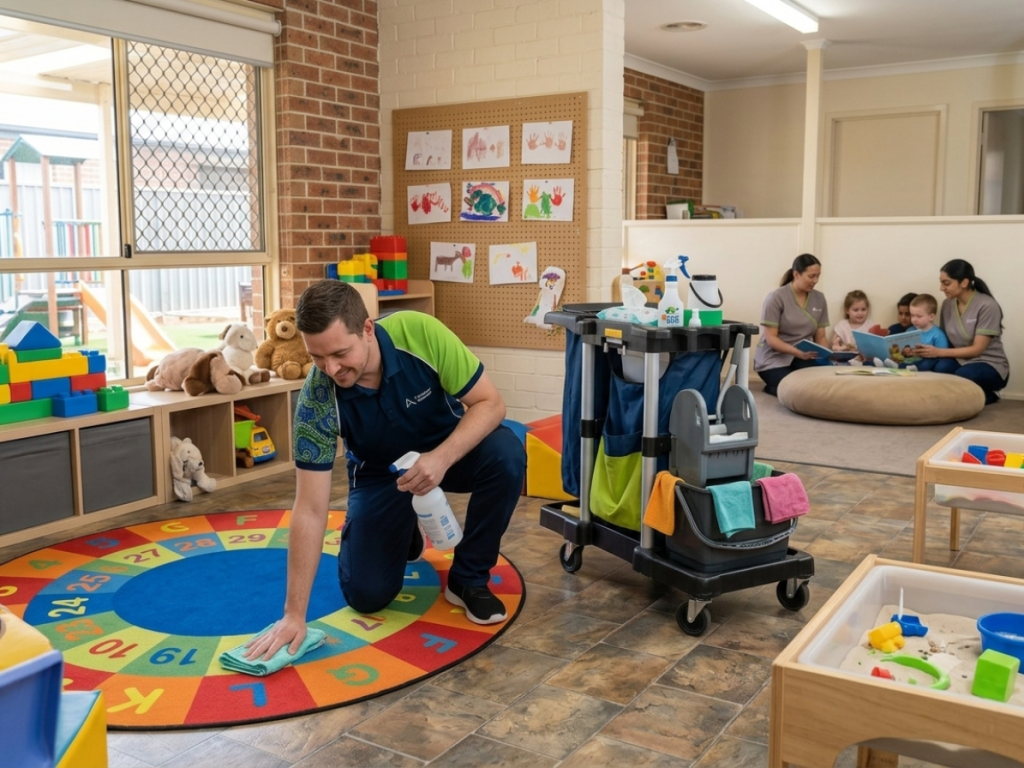
Daily Cleaning Checklist
In a childcare centre, cleaning is shared between educators and the cleaning team. Educators clean as they go during the day, such as wiping the change mat after every nappy. The cleaning team does the full clean once children have gone home. Writing down who does what is the simplest way to stop tasks falling through the gaps.
The lists below show a typical split. Adjust them to your centre, your rooms and your service’s policies.
Playrooms and sleep rooms
| Task | Who |
|---|---|
| Vacuum carpets and rugs, including edges and under furniture | Cleaner |
| Mop hard floors with detergent, paying attention to eating and craft areas | Cleaner |
| Wipe tables, chairs, low shelves, benches and window sills | Cleaner |
| Clean high-touch points: door handles, light switches, gate latches, cupboard handles | Cleaner |
| Clean glass doors and low windows to child height | Cleaner |
| Empty bins, replace liners and clean bins if soiled | Cleaner |
| Wipe cots and sleep mats, and change linen as per policy | Educators (linen) and cleaner (frames, floors) |
| Wipe tables before and after meals | Educators |
Nappy change and toilet areas
| Task | Who |
|---|---|
| Clean the change mat with detergent after every nappy change | Educators |
| Deep clean the change bench, mat, steps and surrounding walls | Cleaner |
| Clean and disinfect toilets, child-height basins, taps and flush buttons | Cleaner |
| Empty and clean nappy bins and sanitary bins | Cleaner |
| Mop floors with detergent, then disinfect around toilets and the change area | Cleaner |
| Restock soap, paper towels, gloves and liners | Cleaner, with educators topping up during the day |
ACECQA’s information sheet on toileting and nappy changing sets out the principles behind these routines.
Kitchens and bottle preparation areas
| Task | Who |
|---|---|
| Clean benches, splashbacks, sinks and taps | Cleaner (end of day), cook (during service) |
| Wipe appliance fronts, fridge handles and microwave interiors | Cleaner |
| Mop floors, including under benches and around bins | Cleaner |
| Empty bins and clean bin lids | Cleaner |
| Clean and sanitise food prep surfaces and utensils | Cook or educators, following the food safety program |
| Clean bottle preparation benches and bottle fridges | Educators, with a weekly cleaner wipe-down |
Toys and play equipment
| Task | Who |
|---|---|
| Remove mouthed toys to a “to be cleaned” tub during the day | Educators |
| Wash mouthed toys in detergent and warm water, rinse and air dry | Educators or cleaner, as agreed in the scope |
| Wipe high-use toys and equipment in baby and toddler rooms | Cleaner or educators, as agreed |
| Clean any toy soiled with body fluids straight away, or remove it | Educators |
Toy cleaning is the task most often left out of contracts. If you want your cleaning team to handle it, write it into the scope with the time it needs.
Entry, office and staff areas
- Clean entry doors, glass and sign-in areas, including tablets and pens
- Vacuum or mop entry floors and shake out mats
- Clean staff toilets and the staff room
- Empty all bins and remove waste to the external bins
Weekly and Periodic Tasks
Daily cleaning keeps the centre safe. Weekly and periodic cleaning stops dirt and germs building up in the places daily cleaning does not reach.
| Frequency | Tasks |
|---|---|
| Weekly | Wipe walls and doors to child height, clean skirting boards, wipe inside bins, clean fridge interiors, dust high surfaces, clean outdoor furniture and play equipment touch points |
| Fortnightly | Detail clean of nappy change and toilet areas, including grout and fittings, wash soft furnishings such as cushions and bean bag covers |
| Monthly | Clean light fittings and air-conditioning vents, wipe inside cupboards, clean blinds |
| Quarterly | Carpet spot cleaning and high-traffic extraction, hard floor machine scrub, internal and external windows |
| Six-monthly to annually | Full carpet extraction, hard floor strip and seal, pressure cleaning of outdoor play areas and paths |
The best time for heavy periodic work is when the centre is closed, such as a public holiday or the Christmas shutdown. Carpets and floors then have time to dry fully before children return. Our guide to end-of-year shutdown cleaning explains how to plan it.
Choosing Child-Safe Cleaning Products
Children are more sensitive to chemicals than adults. They breathe faster, are closer to the floor, and put their hands in their mouths. Product choice matters.
- Detergent and water for most jobs. For routine cleaning, detergent and warm water remove most germs. Keep disinfectants for body fluid spills, toilets, nappy change areas and outbreaks.
- Avoid strong fragrances and aerosols. Scented products and sprays can irritate children with asthma or allergies. Use unscented or low-fragrance products and pump bottles or pre-dosed systems.
- Leave no residue. Wipe or rinse surfaces children touch or mouth, and allow the right contact time before they are used.
- Store chemicals securely. All products should be locked away, out of children’s reach, and never left unattended on a trolley.
- Keep safety data sheets. Every product on site needs a current safety data sheet, kept where staff can find it.
- Use colour-coded equipment. Separate cloths and mops for toilets, kitchens and general areas stop cross-contamination.
Ask your cleaning provider for a list of the products they will use, and check them against your centre’s policies.
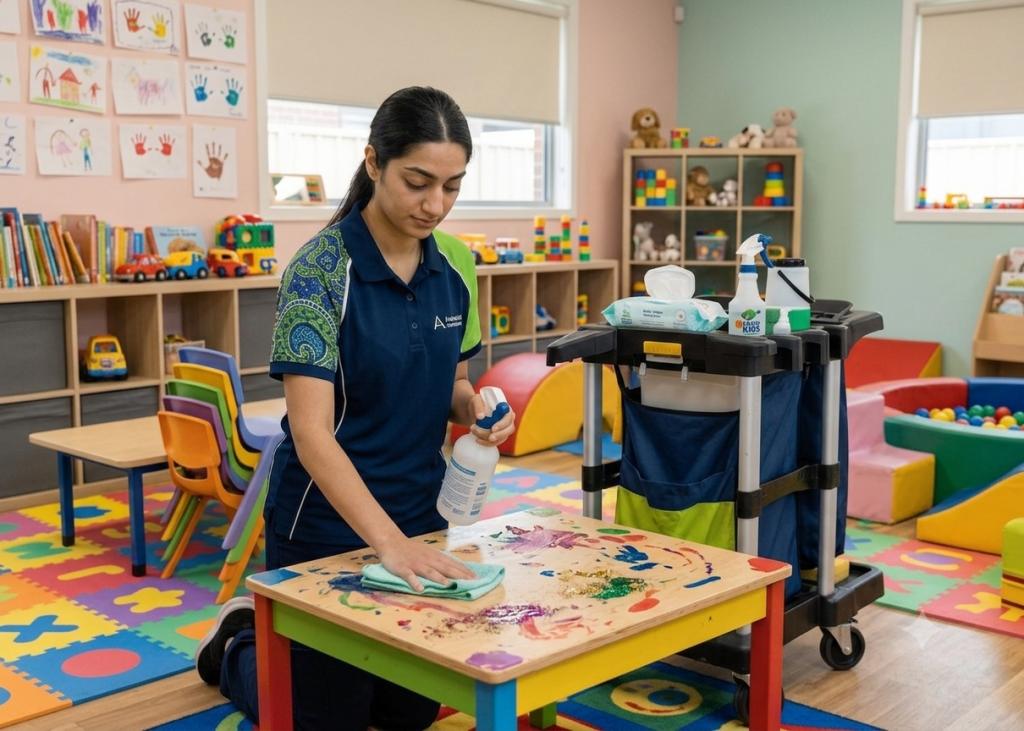
Child-Safe Staff: Checks, Training and Scheduling
Anyone cleaning a childcare centre is working in a child-safe environment, even if they never meet a child. Your provider should take that as seriously as you do.
Working with children checks. Each state runs its own check, such as the Queensland blue card, the NSW Working With Children Check and the Victorian Working with Children Check. Ask your provider to confirm every cleaner on your site holds a current check for your state, and how they monitor expiry dates.
Training. Look for training in infection control, body fluid spills, safe chemical use, and child safety awareness, including how to report a concern.
Conduct rules. Cleaners should follow your centre’s child safe code of conduct. That includes never being alone with a child, signing in and out, and not using personal phones in children’s areas. Under the National Model Code for taking images in early childhood settings and your centre’s device policy, photo evidence of cleaning should never include children and is best taken after hours.
Scheduling. Most centres schedule the main clean after children have gone home. It is safer, faster and avoids wet floors and chemicals around children. Daytime cleaning should be limited to essential tasks, such as restocking or spill response, by cleaners who are inducted, checked and known to staff.
Consistency. A stable team means cleaners know the centre’s routines and staff know who is in the building. Ask how a provider covers leave without sending unfamiliar people.
Records That Support Your NQS Assessment
Assessors want to see that your hygiene practices are planned, followed and reviewed. Cleaning records are part of that evidence for Quality Area 2 and Quality Area 3.
Keep these on file:
- A written cleaning scope that lists each room, task, frequency and who is responsible, educators or cleaners
- Daily cleaning sign-offs for each room, especially nappy change and toilet areas
- Toy cleaning logs showing what was cleaned, when and by whom
- Body fluid spill and outbreak records noting what was cleaned and with what product
- Periodic cleaning records, such as carpet extraction and window cleaning dates
- A chemical register and safety data sheets for every product on site
- Cleaner screening records showing each cleaner’s working with children check number and expiry
- Cleaning audits with issues found and the actions taken
Digital records are easier to keep and harder to dispute. Associated Cleaning records cleaner attendance and task completion through ACS Connect, so centre directors can see what was done and when. Regular, weighted audits, explained in Quality Auditing: Getting It Right, show whether standards are holding over time.
Childcare Cleaning in Brisbane, Sydney and Melbourne
The NQS is national, but working with children checks, climate and local conditions differ. A provider should know your state’s rules and have enough local staff to keep a stable team on your site.
Brisbane and South East Queensland. Every cleaner needs a current Queensland blue card. Heat and humidity also mean more attention to mould in bathrooms and odours in nappy areas. Associated Cleaning provides commercial cleaning Brisbane centres rely on, as well as across the Sunshine Coast and Moreton Bay.
Sydney. Centres in Sydney often share buildings or sit within schools and community facilities, which makes access and after-hours scheduling important. Our school and childcare cleaning Sydney teams work to child-safe procedures, with every cleaner holding a current NSW Working With Children Check.
Melbourne. Victorian centres need cleaners with a current Victorian Working with Children Check and a provider that understands the Victorian Child Safe Standards. We support childcare and education sites across Melbourne alongside our school cleaning services nationally.
For more on cleaning education sites, see our business manager’s guide to school cleaning in Australia.
Frequently Asked Questions
How often should toys be sanitised in childcare?
Toys that children mouth should be removed and cleaned before another child uses them. High-use toys in baby and toddler rooms are usually cleaned daily, and other toys weekly or whenever they look dirty. Detergent and warm water is enough for most toys. Use a disinfectant only after contact with body fluids or during an outbreak. Check Staying Healthy and your centre’s policy for the detail.
Do childcare cleaners need a Working With Children Check?
In practice, yes. The rules differ by state, and some exemptions exist for people who have no contact with children. But almost every centre requires a current check for anyone who works on site, including cleaners who only work after hours. Ask your provider to confirm each cleaner’s check before they start.
Should cleaning happen during or after operating hours?
The main clean should happen after hours, once children have gone home. That keeps chemicals, equipment and wet floors away from children and lets cleaners work faster. During the day, educators handle clean-as-you-go tasks. A daytime cleaner can help with restocking and spills in larger centres, provided they are screened, inducted and follow your conduct rules.
The Bottom Line
Childcare cleaning needs its own procedures because children play, crawl and mouth everything. Write down a clear daily, weekly and periodic checklist, split tasks between educators and cleaners, choose low-residue products, and make sure every cleaner is checked and trained. Keep the records that prove it. That protects children and gives you the evidence your NQS assessment needs.
Associated Cleaning is an Australian commercial cleaning company, established in 1969, providing ISO 9001-certified cleaning services across Brisbane, the Sunshine Coast, Sydney, Melbourne, and Moreton Bay. Every site we service has a site-specific scope, with task completion recorded through our ACS Connect app and Customer Portal. To arrange a free site inspection and a no-obligation quote, call 1300 943 ACS or get a childcare cleaning quote.