
At some point, most facility managers and building owners ask the same question: should we keep cleaning in-house, or bring in a contractor?
It’s rarely a simple answer. The right choice depends on the size of your building, how predictable your cleaning needs are, how much time you have to manage staff, and what level of risk you’re comfortable carrying. This guide breaks down the real cost of cleaning and the trade-offs of each approach, so you can make the decision that actually fits your building — not just the one that sounds simpler on paper.
To help, this In-House Cleaning Staff vs Outsourced Commercial Cleaning: Pros, Cons and Costs guide compares cleaning service options and highlights the benefits of outsourcing commercial cleaning where appropriate.
Cost Comparison: In-House vs Outsourced
Here’s how in-house vs outsourced models compare on the real cost of cleaning and overall value.
The true cost of in-house cleaning staff
On the surface, hiring your own cleaner or cleaning team can look cheaper than a contractor’s quote. But the full cost of in-house cleaning goes well beyond wages. You’re also carrying:
- Superannuation, leave entitlements, and payroll tax
- Recruitment and onboarding costs
- Cleaning equipment purchase and maintenance
- Consumables and chemical supply and storage
- Sick leave and annual leave cover
- Ongoing training and compliance costs
- Management time — someone has to supervise, roster, and handle issues
Once these are factored in, in-house cleaning often costs more than expected, particularly for buildings without the scale to justify a full-time, dedicated cleaning role.
The true cost of outsourced cleaning
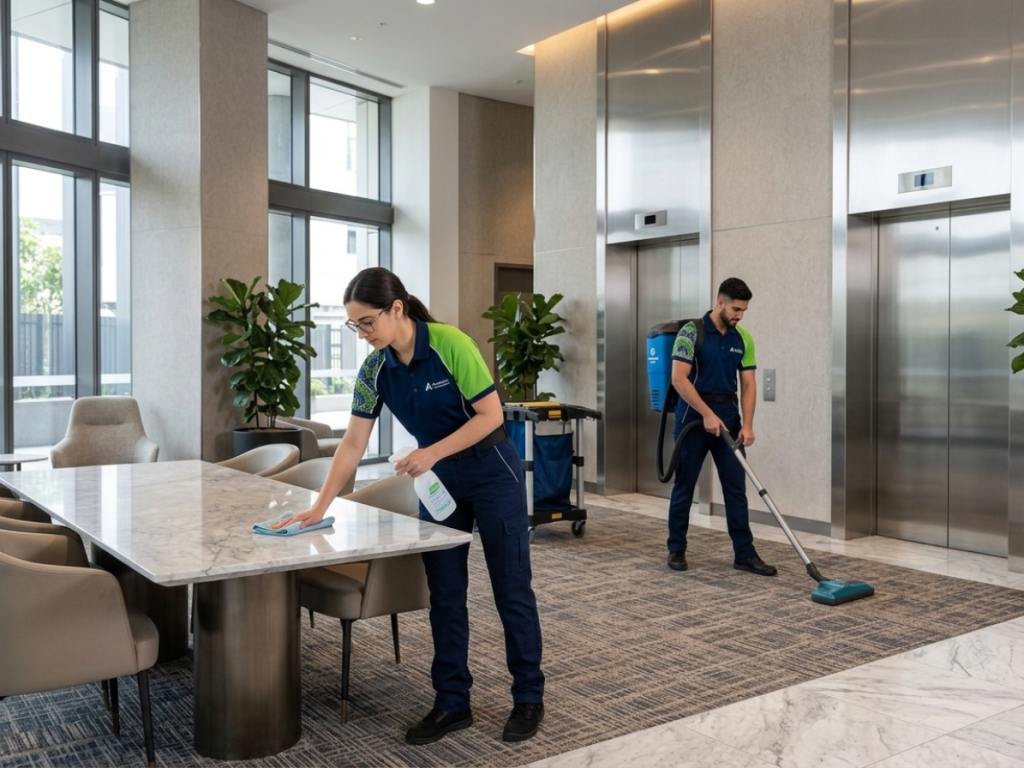
An outsourced cleaning contract typically bundles all of the above into a single, predictable line item. By outsourcing cleaning, you’re paying for labour, consumables, equipment, supervision, and cover for absences — all managed by the contractor. This makes budgeting simpler and removes a layer of hidden costs that often get missed in an in-house cost comparison.
The trade-off is that you’re paying a margin for that convenience and risk transfer. For very large buildings with consistent, high-volume cleaning needs, an in-house team can sometimes work out more cost-effective at scale — but this is the exception rather than the rule for most commercial buildings.
Management and Liability Considerations
Who’s responsible when something goes wrong?
With in-house staff, your organisation carries full responsibility for WHS compliance, insurance, staff conduct, and performance management. If a cleaner is injured on the job, if equipment isn’t maintained correctly, or if a workplace complaint arises, it sits with you as the employer.
With an outsourced contractor, that liability largely shifts to the provider. A reputable commercial cleaning company will carry its own WHS systems, insurance, and staff management processes — meaning less direct exposure for your organisation. It’s worth confirming a contractor’s insurance and compliance credentials before signing. Our ISO 14001 vs ISO 9001 guide covers what to look for here.
Who manages performance and rostering?
In-house cleaning means you or a member of your team is responsible for rostering, managing sick days, resolving conflicts, and handling underperformance. This is a real time cost that’s easy to underestimate — particularly for facility managers already juggling multiple responsibilities across a building or portfolio.
Outsourcing shifts this operational burden to the contractor’s account or area manager, who is responsible for staffing your site correctly and resolving day-to-day issues without you needing to intervene.
Quality Control and Consistency
In-house: direct oversight, but less resilience
One advantage of in-house cleaning is direct line of sight — you know exactly who is cleaning your building and can address issues immediately. However, this model is more vulnerable to disruption. If your cleaner is sick, on leave, or resigns, you may be left without cover unless you’ve built in redundancy, which most small in-house teams haven’t.
Outsourced: built-in redundancy, but requires a good SLA
A contractor with a broader workforce can typically provide cover for staff absences without disruption to your cleaning schedule. The trade-off is that quality can vary between individual cleaners unless the contractor has strong supervision, quality checks, and a clear Service Level Agreement in place (see our guide on what to look for in a cleaning contract). A vague or poorly defined contract is one of the most common causes of dissatisfaction with outsourced cleaning — the solution is a detailed SLA, not necessarily a switch back to in-house.
Flexibility and Scalability
In-house teams are generally fixed in size and difficult to scale quickly. If your cleaning needs increase — a new floor, an event, a seasonal deep clean — you’ll need to hire, redeploy existing staff, or bring in a contractor for the gap anyway.
Outsourced cleaning is inherently more flexible. Contractors can typically scale staffing up or down, provide one-off or periodic services (such as carpet cleaning or window cleaning) without a separate hiring process, and adjust cleaning frequency as your building’s needs change — for example, during a tenancy change or a shift to hybrid working patterns.
When In-House Makes Sense (and When It Doesn’t)
If you’re weighing in-house cleaning staff vs outsourced cleaning, consider the following scenarios when deciding which path suits you best.
In-house cleaning tends to make the most sense when:
- You manage a single, large building with high, consistent cleaning volume
- You have the internal HR and WHS infrastructure to manage staff properly
- You want maximum direct control over staff and scheduling
- Cleaning is central enough to your operations that dedicated internal management is worth the investment
Outsourcing tends to make more sense when:
- You manage multiple sites or a smaller building where a full-time role isn’t justified
- You want to reduce administrative burden and WHS liability
- Your cleaning needs fluctuate or require specialist services occasionally
- You’ve experienced high staff turnover or difficulty covering absences internally
For most commercial office buildings, the balance tips toward outsourcing — largely because of the hidden management time and liability that come with running an internal team, not just the headline cost comparison.
Making the Switch: What to Expect
If you’re moving from in-house cleaning to an outsourced provider, a good contractor will typically:
- Conduct a site walkthrough to scope your building’s specific requirements
- Provide a clear proposal outlining frequency, scope, and pricing
- Offer a defined onboarding and transition period
- Set up a Service Level Agreement with measurable standards
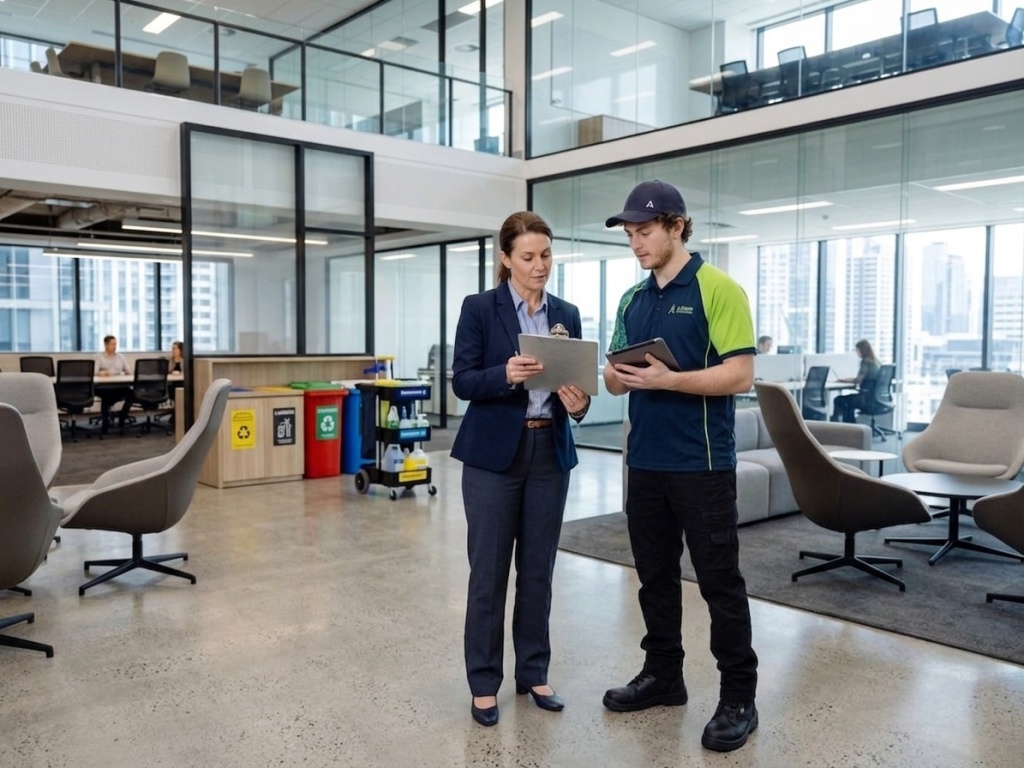
- Assign a dedicated point of contact for ongoing management
As you evaluate cleaning service options, the transition is usually more straightforward than facility managers expect, particularly when the scope is clearly defined upfront — which is where a well-prepared RFP makes a real difference.
The Bottom Line
There’s no universally right answer between in-house and outsourced cleaning — it depends on your building’s size, your internal capacity to manage staff, and how much risk and administrative burden you want to carry directly. What matters most is making the comparison honestly, including the hidden costs of whichever model you’re currently using, rather than comparing a simple hourly rate against a full-service contract.
If you’re asking “should I outsource office cleaning?”, it’s worth getting a proper cost comparison done for your specific building rather than relying on rules of thumb — the right answer often becomes clear once the full picture is on the table.
Associated Cleaning has been providing commercial cleaning across Australia since 1969. Get in touch for a tailored cost comparison for your building.
Frequently Asked Questions
Question: Is outsourcing always cheaper than keeping cleaning in-house?
Not always. Outsourcing usually delivers more predictable, all-in pricing that includes labour, consumables, equipment, supervision, and absence cover—so for most offices it’s better value once hidden costs are counted. Very large, stable sites with consistent high-volume needs and strong internal HR/WHS can sometimes run in-house more cost-effectively at scale, but that’s the exception.
Question: What hidden costs are typically missed when calculating in-house cleaning?
Beyond wages, in-house costs commonly include:
- Superannuation, leave entitlements, and payroll tax
- Recruitment and onboarding
- Equipment purchase, maintenance, and storage
- Consumables and chemicals
- Sick leave and annual leave cover
- Ongoing training and compliance
- Management time for supervision, rostering, and issue resolution
- When these are added, in-house often costs more than it first appears—especially for buildings without the scale to justify a full-time role.
Question: What liabilities shift to the contractor if we outsource?
With an outsourced provider, much of the WHS compliance, insurance, staff conduct, and performance management responsibility moves to the contractor. A reputable company brings its own WHS systems, insurances, supervision, and cover for absences. You should still verify their insurance and compliance credentials before signing and ensure the contract clearly defines responsibilities.
Question: How do we ensure quality and consistency with an outsourced cleaner?
Make the Service Level Agreement (SLA) specific and measurable. Quality is strongest when the contractor provides:
- Clear scope and frequency by area/task
- Defined standards and KPIs, plus regular quality checks
- Named supervision and a dedicated point of contact
- Procedures for covering absences and handling underperformance
- Most dissatisfaction stems from vague scopes; the fix is a stronger SLA, not necessarily switching back in-house.
Question: When does in-house make sense versus outsourcing?
In-house suits a single, large building with high, consistent cleaning volume, strong internal HR/WHS capability, and a need for maximum direct control—where dedicated internal management is justified. Outsourcing suits multiple sites or smaller buildings, fluctuating needs or periodic specialist services, and teams looking to reduce admin burden and WHS liability or improve coverage during absences. For most commercial offices, outsourcing is the better fit once total costs and management time are included.